
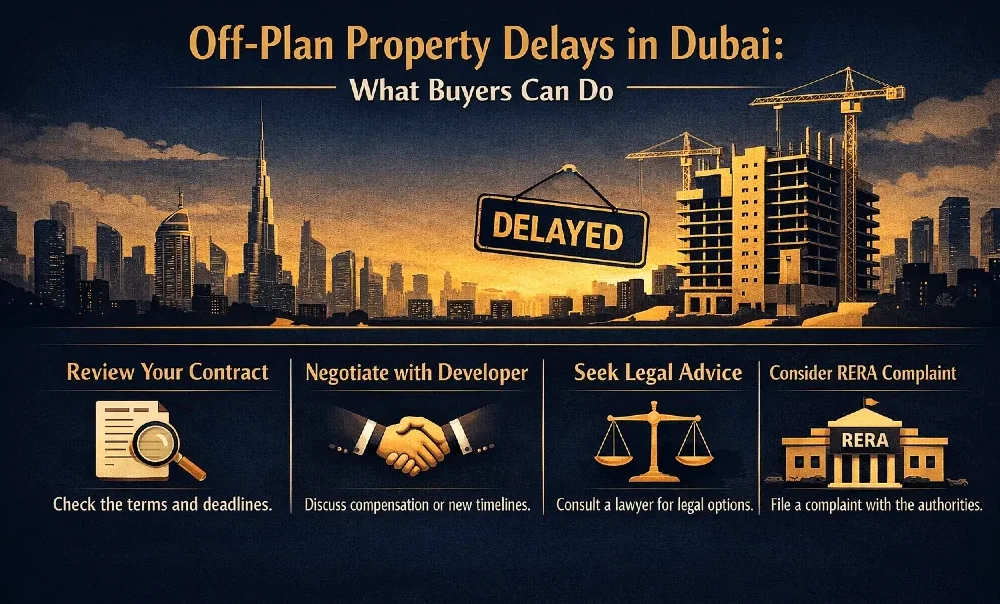
Off-plan property delays in Dubai are a common issue. Because off-plan properties are a typical feature in Dubai’s real estate market. Buyers enter into agreements to buy properties before construction is complete. The price is normally based on a plan agreed upon in the Sale and Purchase Agreement (SPA), which outlines payments and expected completion dates.
These delays may affect the overall financial position or rental income for buyers. Before deciding on a course of action, it is important to understand the implications of a delay and the relevant law in the UAE.
Quick Navigation
ToggleWhat Are Off-Plan Property Delays in Dubai?
An off-plan property delays in dubai occurs when the developer does not deliver the property within the timeframe agreed upon in the SPA.
In most cases:
- the contract includes an estimated completion date
- a grace period may be provided (often 6–12 months)
- handover is expected once construction and approvals are complete
A delay becomes legally relevant when:
- the grace period has expired
- the project progress does not match contractual timelines
- the buyer is unable to use or benefit from the property as expected
Why Off-Plan Property Delays in Dubai Happen
Delays are not always caused by a single issue. In practice, they may result from:
- construction or contractor delays
- regulatory or approval processes
- financial issues affecting the developer
- changes in project scope or design
- wider market conditions
While some delays may be justified under the contract, others may raise questions about compliance with the agreed terms.
Understanding the Sale and Purchase Agreement (SPA)
The SPA is the key document in any off-plan dispute.
It usually defines:
- the expected completion date
- the developer’s obligations
- payment schedules
- delay clauses and grace periods
- remedies available to the buyer
In many cases, the SPA allows for limited delays. However, once those limits are exceeded, the buyer may have legal grounds to take further action.
Careful review of the SPA is essential before making any decision.
What to Check Before Signing an SPA in Dubai?
- Property Details and Parties
Verify the plot or unit number, area, and type (off-plan/ready). Confirm the seller/developer’s RERA license via the DLD portal.
- Payment Schedule and Escrow
Milestones must match construction (e.g., 10% deposit, 50% construction, 40% handover). Escrow via Ejari/Oqood is mandatory for off-plan.
- Handover and Delay Clauses
Define date and penalties (e.g., 1% monthly). Check force majeure scope—COVID clauses now limited.
- Defects and Snagging Rights
30-day snagging period post-handover. Liability for latent defects up to 10 years.
- Termination and Refund Terms
Buyer termination: full refund + interest if developer faults. Seller termination rights restricted post-Law 13 updates.
- DLD Registration Requirements
Must register within 7 days. Unregistered SPAs voidable.
- Developer and Seller Warranties
Title free of liens. Developer solvency proof.
- Red Flags to Watch For
Vague penalties, unlimited force majeure, no escrow, aggressive termination.
What Buyers Can Do When a Delay Occurs
The appropriate response depends on the situation, but common steps include:
- Review Project Status
Understanding the actual construction progress is important. This may involve:
- checking updates from the developer
- reviewing project registration details
- verifying status through the Dubai Land Department (DLD)
- Assess Contractual Rights
The SPA determines what rights the buyer may have.
This document includes:
- whether the delay exceeds the agreed period
- whether compensation clauses apply
- whether termination rights exist
- Communicate with the developer.
Structured communication can clarify the issue in some cases.
This may involve:
- requesting updated timelines
- confirming reasons for delay
- documenting all responses
Informal communication should be handled carefully, as it may later form part of the legal record.
- Consider the legal notice.
If the delay continues without clear resolution, a formal legal notice may be appropriate.
A notice typically
- refers to the contractual obligations
- highlights the delay
- requests compliance or clarification
- sets out potential next steps
- Evaluate Termination or Compensation Options
Depending on the contract and circumstances, buyers may consider the following:
- continuing with the project
- seeking compensation (if applicable)
- terminating the agreement
- filing a legal claim
Each option has legal and financial implications that should be assessed carefully.
Dubai Land Department and RERA Role
The Dubai Land Department (DLD) and Real Estate Regulatory Agency (RERA) play an important role in overseeing real estate projects.
They may:
- regulate developer obligations
- monitor project registration
- provide frameworks for dispute handling
In some cases, disputes may involve:
- escrow account considerations
- project status verification
- regulatory compliance
Understanding how these authorities operate helps in assessing the available options.
Common Buyer Concerns
Buyers facing delays often have similar concerns:
- whether they can recover payments
- whether they are entitled to compensation
- whether the project will be completed
- whether they can exit the agreement
- how long the process may take
These questions depend largely on the contract terms and the specific facts of the case.
What Buyers Should Avoid
Certain actions may weaken a buyer’s position:
- stopping payments without legal basis
- relying on verbal assurances
- failing to document communication
- delaying action for too long
- signing amended agreements without review
A structured approach helps avoid unnecessary risk.
When Does a Delay Become a Legal Dispute?
A delay becomes a legal issue when:
- contractual obligations are no longer being met
- the developer fails to provide reasonable justification
- the buyer suffers financial or practical impact
- attempts to resolve the issue informally are unsuccessful
At this stage, legal advice can help clarify whether formal action is appropriate.
Why Early Legal Advice Matters
Delayed action often complicates many off-plan disputes.
Early legal review can help:
- interpret the SPA correctly
- identify enforceable rights
- assess whether termination is possible
- structure communication with the developer
- prepare for potential claims
In some cases, early intervention may lead to a more controlled resolution.
Off-Plan Investment and Risk Awareness
Off-plan purchases carry inherent risks, particularly in markets where projects develop over time.
Understanding:
- contractual obligations
- regulatory frameworks
- practical risks
helps buyers make informed decisions, both before and after entering into the agreement.
When to Speak with a Real Estate Lawyer in Dubai
You may consider legal advice if:
- the project is significantly delayed
- communication with the developer is unclear
- you are considering termination or compensation
- you are unsure of your contractual rights
Speaking with a real estate lawyer in Dubai can help you understand your position and evaluate the next step based on your specific circumstances.
FAQ Section
Is SPA notarization required?
No, but registration is.
What if delays occur?
Claim penalties via RDC or court.
Can I assign the SPA?
Yes, with seller consent.
Should I stop payments if there are off-plan property delays in Dubai?
Not without legal advice. Stopping payments without a proper basis can weaken your position and create additional risk.
Conclusion
Off-plan property delays in Dubai, while frustrating, are navigable with proper understanding of SPA terms, regulatory protections, and strategic timing. Early documentation, structured communication with the developer, and assessment of contractual remedies position buyers to protect their investment without unnecessary escalation. For those facing significant delays or uncertainty about rights under Dubai Law No. 13 of 2008, consulting a real estate lawyer in Dubai provides the clarity needed to pursue compensation, enforce handover, or pursue termination effectively while minimizing financial exposure.