
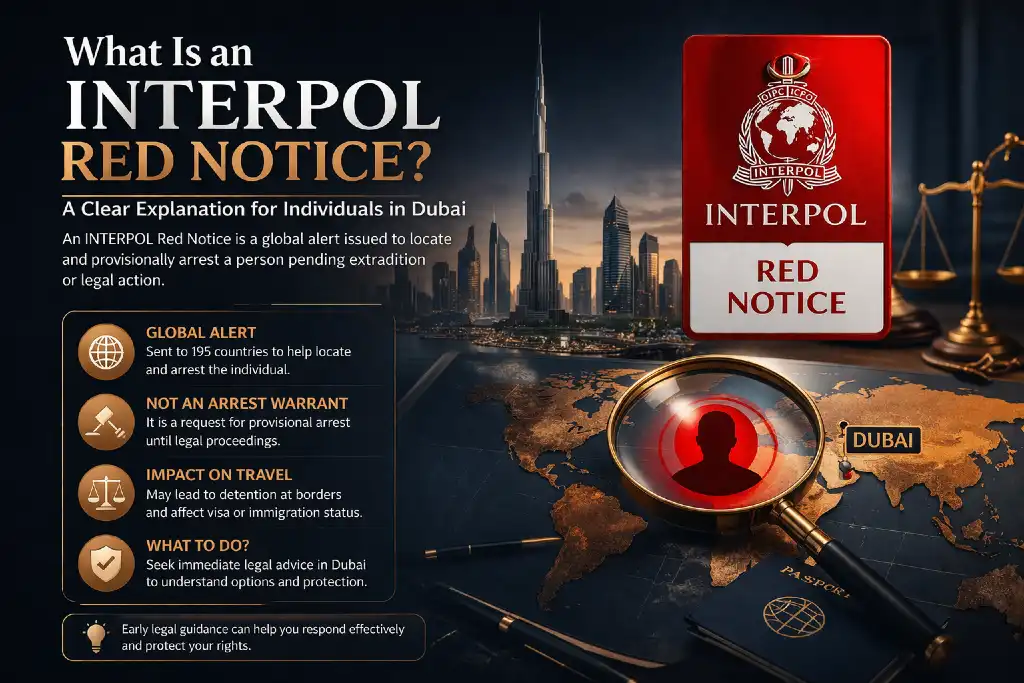
An Interpol Red Notice is a request sent through an international police network asking authorities to locate a person and, in some cases, consider provisional arrest for extradition purposes.
However, it is important to understand how it actually works in practice.
An Interpol Red Notice does not automatically mean that a person will be arrested. Each country, including the UAE, decides independently whether and how to act on it under its own laws.
This means the impact of a Red Notice can vary. In some situations, it may lead to restrictions or legal action. In others, it may have no immediate effect.
Why Interpol Red Notice Matters in Dubai
Dubai is an international hub for business, travel, and residence. Cross-border legal matters may affect individuals connected to multiple jurisdictions.
An interpol red notice can arise in situations involving
- financial disputes
- criminal allegations in another country
- business-related conflicts
- ongoing investigations abroad
In some cases, individuals may not even be aware that a notice exists until they face travel restrictions or are contacted by authorities.
Step-by-Step: How a Red Notice Works
Understanding the process helps reduce confusion and allows individuals to respond more carefully.
- Request from a Member Country
A n Interpol Red Notice begins when a country requests Interpol to circulate a notice concerning an individual.
The request is typically based on:
- a national arrest warrant
- an ongoing criminal case
- an intention to seek extradition
- Interpol Review Process
Interpol does not automatically publish every request.
It reviews whether the request complies with its rules, including the following:
- whether the matter is criminal (not political or civil)
- whether it aligns with Interpol’s constitution
- whether sufficient information is provided
- Publication of the Red Notice
If accepted, the Red Notice is shared through Interpol systems.
It may:
- be visible to law enforcement authorities
- in some cases, appear on Interpol’s public database
- remain confidential depending on the circumstances
- Action by Local Authorities
Each country decides how to respond.
In the UAE, authorities may:
- monitor the individual’s status
- impose travel restrictions
- take action depending on the situation
There is no automatic or uniform response it depends on the legal framework and the case details.
- Possible Extradition Process
If an individual is located, the requesting country may proceed with extradition.
This process involves:
- legal procedures under UAE law
- court review of the request
- assessment of whether extradition conditions are met
You Can Also Read the official guidance. Here: What is An Interpol Red Notice?
And you may also read about declared current red notices here: Current Declared Red Notices.
Interpol vs Local Law
One of the most misunderstood aspects of Red Notices is the difference between Interpol and national authorities.
- Interpol facilitates communication between countries
- Local authorities decide what action to take
This process means:
- a Red Notice does not automatically result in arrest
- enforcement depends on UAE law and procedures
Understanding this distinction is important when assessing risk.
Common Situations Where Red Notices Arise
Red notices are often associated with serious criminal allegations, but in practice, they can arise in a range of situations, including:
- financial or business disputes that escalate
- allegations of fraud or breach of trust
- unresolved legal cases in another jurisdiction
- cross-border commercial conflicts
Each case depends on the legal system of the requesting country and the nature of the allegation.
Why Red Notices Create Uncertainty
For many individuals, the main difficulty is not only the notice itself but also the uncertainty around it.
Questions often include:
- Is the notice valid?
- Will I be arrested in Dubai?
- Can I travel?
- What happens if I leave the UAE?
Because each situation is different, the impact of a Red Notice can vary significantly.
Theory of What If…
What if I didn’t know about the Red Notice?
This can happen. Some individuals only discover a notice when:
- traveling
- dealing with immigration issues
- being contacted by authorities
What if the issue is civil, not criminal?
Interpol rules generally exclude purely civil matters. However, depending on the jurisdiction, some cases may present disputes as criminal.
What if I am already in Dubai?
The response depends on:
- the nature of the case
- UAE legal procedures
- any existing agreements between countries
What if I need to travel?
Travel may carry risk if an Interpol Red Notice is active, particularly when crossing borders.
Risks and Practical Implications
A Red Notice can affect several areas:
- international travel
- immigration status
- business activities
- reputation
- interaction with authorities
In some cases, the risk is immediate. In others, it develops over time depending on how the situation is handled.
Why Early Understanding Matters
Many individuals react only when the situation becomes urgent.
Understanding the position early can help:
- assess the level of risk
- clarify the legal situation
- avoid unnecessary complications
- plan next steps more carefully
Even where no immediate action is required, clarity can reduce uncertainty.
Soft Legal Explanation
Situations involving Interpol notices often involve multiple legal systems and procedures. Understanding how international requests interact with UAE law is an important part of assessing the situation.
In practice, individuals dealing with cross-border issues often need to consider the following:
- how the notice was issued
- whether it complies with applicable rules
- how local authorities may respond
Approaching the situation in a structured way helps reduce unnecessary risk.
What the CCF Does

The Commission for the Control of Interpol’s Files, often referred to as the CCF, is the body that reviews certain challenges relating to Interpol data. In appropriate cases, it may consider whether a notice should be corrected, deleted, or restricted.
A CCF request is not something to file casually. It should be based on a structured legal analysis, clear evidence, and a carefully drafted case theory. Poorly prepared applications can waste time and weaken your position.
Common Mistakes People Make
People facing Red Notice issues often make avoidable mistakes in the first 24 to 72 hours.
The most common mistakes are the following:
- Assuming the notice is harmless.
- Posting about the case online.
- Contacting the requesting party directly without advice.
- Traveling before understanding the risk.
- Ignoring the underlying warrant or case.
- Submitting rushed complaints without legal review.
In these matters, a bad first response can make a difficult case harder.
FAQ (Frequently Asked Questions)
Is a Red Notice the same as an arrest warrant?
No. It is a request for cooperation between countries, not an automatic arrest warrant.
Can I be arrested in Dubai because of a Red Notice?
It depends on the case and UAE legal procedures. Each situation is assessed individually.
Can a Red Notice be removed?
In some cases, removal may be possible through specific procedures, depending on the circumstances.
Is a Red Notice public?
Some notices are public, while others are only visible to law enforcement authorities.
Does a Red Notice affect travel?
It can affect travel, particularly when crossing international borders.
Should I travel if I think I am on a Red Notice?
You should get legal advice first. Travel without understanding the risk can be dangerous.
Conclusion
Understanding an Interpol Red Notice is the first step toward managing its risks effectively in Dubai. While the notice itself creates uncertainty around travel, business, and legal exposure, early clarity—through proper assessment of the underlying case, UAE procedures, and potential remedies like CCF review—can help you respond with confidence rather than panic. Consulting an experienced Interpol and extradition lawyer in Dubai provides the needed structured guidance.