
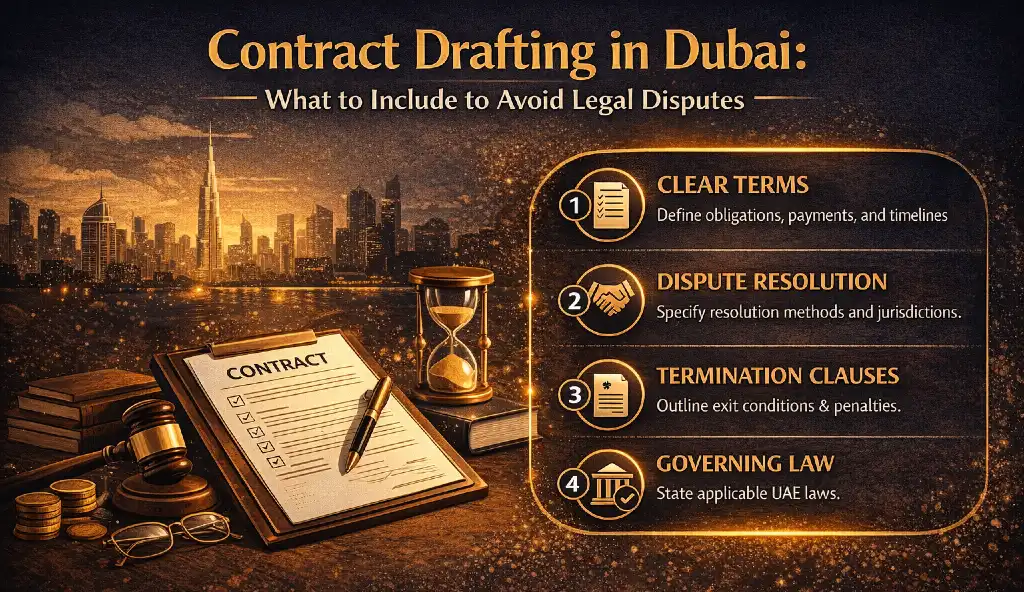
A contract drafting in Dubai is not just a formality; it is the foundation of how a business relationship will be interpreted if something goes wrong.
At a minimum, a well-drafted contract in the UAE should clearly define:
- the scope of work or obligations
- payment terms and timelines
- responsibilities of each party
- termination conditions
- dispute resolution mechanisms
Most disputes do not happen because there was no contract they happen because the contract was unclear, incomplete, or not aligned with how the relationship actually worked.
Quick Navigation
ToggleWhy Contract Drafting in Dubai Matters
In Dubai’s fast-paced commercial environment, parties often make agreements quickly. In practice, many contracts are copied from templates, reused from previous deals, or drafted without considering how UAE law applies.
This creates gaps.
When a dispute arises, the contract becomes the primary reference point. If key terms are missing or unclear, resolving the issue becomes more complicated, time-consuming, and uncertain.
Step-by-Step: What to Include in a Contract in Dubai
This section is where most of the real value lies. A contract should not just exist it should work.
- Clearly Defined Parties
The contract should accurately identify:
- full legal names of all parties
- company registration details (if applicable)
- authorized signatories
Errors at this stage can create enforceability issues later.
- Scope of Work or Obligations
One of the most common sources of disputes is unclear scope.
The contract should specify:
- what is being delivered
- how it will be delivered
- timelines and milestones
- what is not included
Vague descriptions often lead to disagreements about expectations.
- Payment Terms and Structure
Payment clauses should go beyond stating an amount.
They should include:
- total contract value
- payment schedule
- method of payment
- consequences of delay or non-payment
In Dubai, many disputes arise from delayed payments rather than complete non-payment.
- Timelines and Deadlines
Timeframes should be realistic and clearly stated.
This includes:
- start date
- completion date
- interim deadlines (if applicable)
Where delays are possible, the contract should address how they are handled.
- Responsibilities of Each Party
Each party’s obligations should be clearly defined.
This helps avoid situations where:
- one party assumes something is included
- the other party believes it is not their responsibility
Clarity here reduces friction during execution.
- Termination Clause
A contract should explain how it can end.
This may include:
- termination for breach
- termination for convenience
- notice periods
Without a clear termination clause, exiting an agreement can become complicated.
- Dispute Resolution Mechanism
This clause is one of the most important and often overlooked sections.
The contract should specify:
- governing law (UAE law, in most cases)
- jurisdiction (Dubai courts or arbitration)
- dispute resolution process
Without this, resolving disputes becomes less predictable.
- Liability and Risk Allocation
Contracts should address:
- limitations of liability
- indemnities
- risk allocation between parties
This provision helps define responsibility if something goes wrong.
How Contracts Are Interpreted in the UAE
In the UAE, contracts are not interpreted only based on wording.
Authorities may consider:
- the written agreement
- the intention of the parties
- how the contract was actually performed
This phrase means:
What you do in practice can influence how the contract is interpreted
A contract that looks strong on paper but is not followed in reality may create complications.
You can also read the ruling law in this matter. Here: Law No. (6) of 1997
Why Contracts Still Fail
Even when contracts exist, issues still arise.
Common reasons include:
- using generic templates not adapted to the transaction
- unclear or overly broad wording
- missing key clauses
- inconsistent communication between parties
- changes made verbally but not documented
In many disputes, the contract exists, but it does not properly reflect the agreement.
If Theory:
What if the other party delays payment?
The contract should define:
- penalties or consequences
- whether work can be suspended
What if the scope changes mid-project?
Without written variation terms:
- disagreements may arise over additional costs
What if one party stops performing?
The contract should address:
- breach
- notice requirements
- termination rights
What if there is no written contract?
In some cases:
- emails or communications may still be considered
- but the position becomes less certain
Risks of Poor Contract Drafting
Poorly drafted contracts can lead to:
- financial loss due to unclear payment terms
- disputes over scope or obligations
- delays in resolving disagreements
- difficulty enforcing rights
- increased legal costs
Often, the issue is not the dispute itself but the lack of clarity in the original agreement.
Why Getting It Right Early Matters
A contract is not only used when things go wrong it helps prevent issues from arising in the first place.
Clear agreements:
- reduce misunderstandings
- align expectations
- create a structured working relationship
Taking time to structure the agreement properly at the beginning often avoids more complex issues later.
While many contracts start from templates or prior agreements, adapting them to the specific transaction is often where the real value lies.
Businesses dealing with:
- high-value agreements
- long-term partnerships
- cross-border transactions
often review contracts more carefully to ensure they reflect both the commercial reality and the legal framework in Dubai.
Understanding how a contract may be interpreted is just as important as drafting it.
Contract incoming? Book a review with our business law team.
FAQ (Frequently Asked Question)
Do contracts need to be in Arabic in Dubai?
In some cases, Arabic may be required for official proceedings, but contracts are often drafted in English. Translation may become relevant if a dispute arises.
Are verbal agreements enforceable in the UAE?
They can be, but they are more difficult to prove compared to written agreements.
Can I use a template contract?
Templates can be a starting point, but they often need adjustment to reflect the specific transaction and UAE legal context.
What happens if a contract is unclear?
If a dispute arises, unclear terms may be interpreted based on intent, conduct, and supporting evidence, which can create uncertainty.
Is arbitration better than court in Dubai?
It depends on the agreement. Some contracts prefer arbitration for confidentiality, while others rely on court jurisdiction